Thanks! We have received your form submission, we'll get back to you shortly!
Oops! Something went wrong while submitting the form
Landscape design in Castle Pines starts with three things: the design review rules that apply to your community, heavy clay soil, and the way your lot drains toward the gulches and creeks nearby. Ivy Street Design has designed Denver metro landscapes since 1992, and these are the issues we plan around first on a south metro lot.
Quick Summary
Plan approvals, drainage and soil first, in that order. Design review can shape what you are allowed to build, drainage decides where water goes, and soil decides whether plants survive. A planting palette or patio layout comes after those three are settled, because each one can change the whole plan.
Castle Pines is in Douglas County, about 20 miles south of downtown Denver on Interstate 25. It sits on the Colorado Piedmont, along the western edge of the Great Plains. That setting gives you open sky, rolling ground and real wind, so plans here need to work with the land instead of fighting it.
Ivy Street Design starts every project with site analysis. We walk the lot, read the slopes and look at where water already moves. A 3D presentation then lets you see the plan before anything is built. Construction observation follows, so the finished work matches the design.
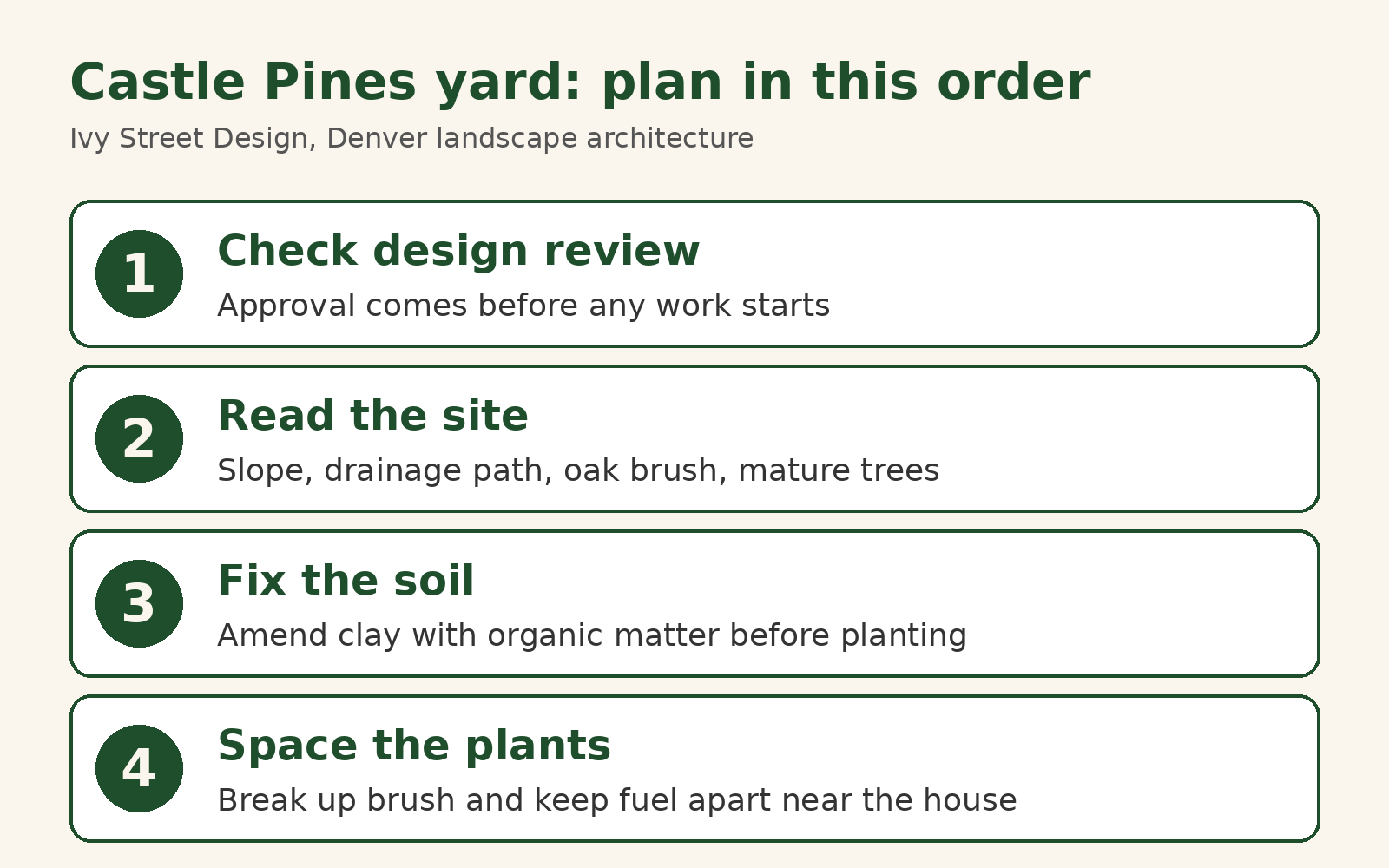
In many Castle Pines communities, yes. The Village at Castle Pines requires its Design Review Committee to approve new landscaping and revised landscaping before work begins. Check which association covers your lot, then confirm what it requires before you hire anyone.
The Village at Castle Pines lists trees, shrubs, water features, boulders and sod as landscaping items that need review. It also lists fire pits, retaining walls, sports courts, outdoor kitchens and lighting as hardscape items. The committee works with your landscaper on an approved plant list.
Two details from that community's guidance matter for planning:
Other Castle Pines neighborhoods have their own rules. Ask your association for its guidelines early, and bring them to the first design meeting. A plan drawn around the rules from day one avoids rework later.
It means you should improve the soil before you plant. Colorado State University Extension notes that soil left after construction is mostly heavy clay, very light sand, or shallow and rocky ground in the foothills. Clay absorbs water slowly, so unamended beds can stay soggy or shed water.
CSU Extension recommends organic amendments such as compost. It says they open air space in clay and help sandy or rocky soil hold water. Its guidance is to spread one to three inches of organic material and work it into the top six to eight inches of soil. It also notes that construction often strips away topsoil.
For a Castle Pines homeowner, that has practical effects:
Drainage decides where walls, steps and beds can go. Happy Canyon Creek runs through the western part of Castle Pines, and Newlin Gulch and South Newlin Gulch run through the eastern part. All three drain to the Cherry Creek watershed, which tells you water moves across this terrain.
That is a regional fact, not a statement about your lot. Your own yard may have a swale, a downspout outlet or a slope that sends runoff toward a neighbor. We map those paths during site analysis, then shape grades, steps and planting so water has a clear route away from the house.
On sloped lots, terraces and retaining walls often do double duty. They create flat usable space and slow runoff. Our retaining wall guide covers what to plan first: Retaining Wall Design in Denver: What to Plan First. Because retaining walls are on the review list in The Village at Castle Pines, get approval before you build.
Keep brush from forming a continuous mass near the home. CSU Extension says wildfire mitigation focuses on breaking up the continuity of fuels, and it gives spacing guidance for brush: 2.5 times the height of the vegetation between clumps.
Gambel oak, often called oak brush, grows along the Front Range and resprouts vigorously after cutting. CSU Extension describes brush treatment of at least 75 feet from a structure on level ground, with larger distances on slopes. Whether those distances apply to your lot is a question for your fire district and your association.
CSU also recommends a mix of shrub species, sizes and densities. In design terms, that means planting in drifts with open space between them instead of one solid wall of shrubs. It also keeps the yard looking natural while you manage fuel.
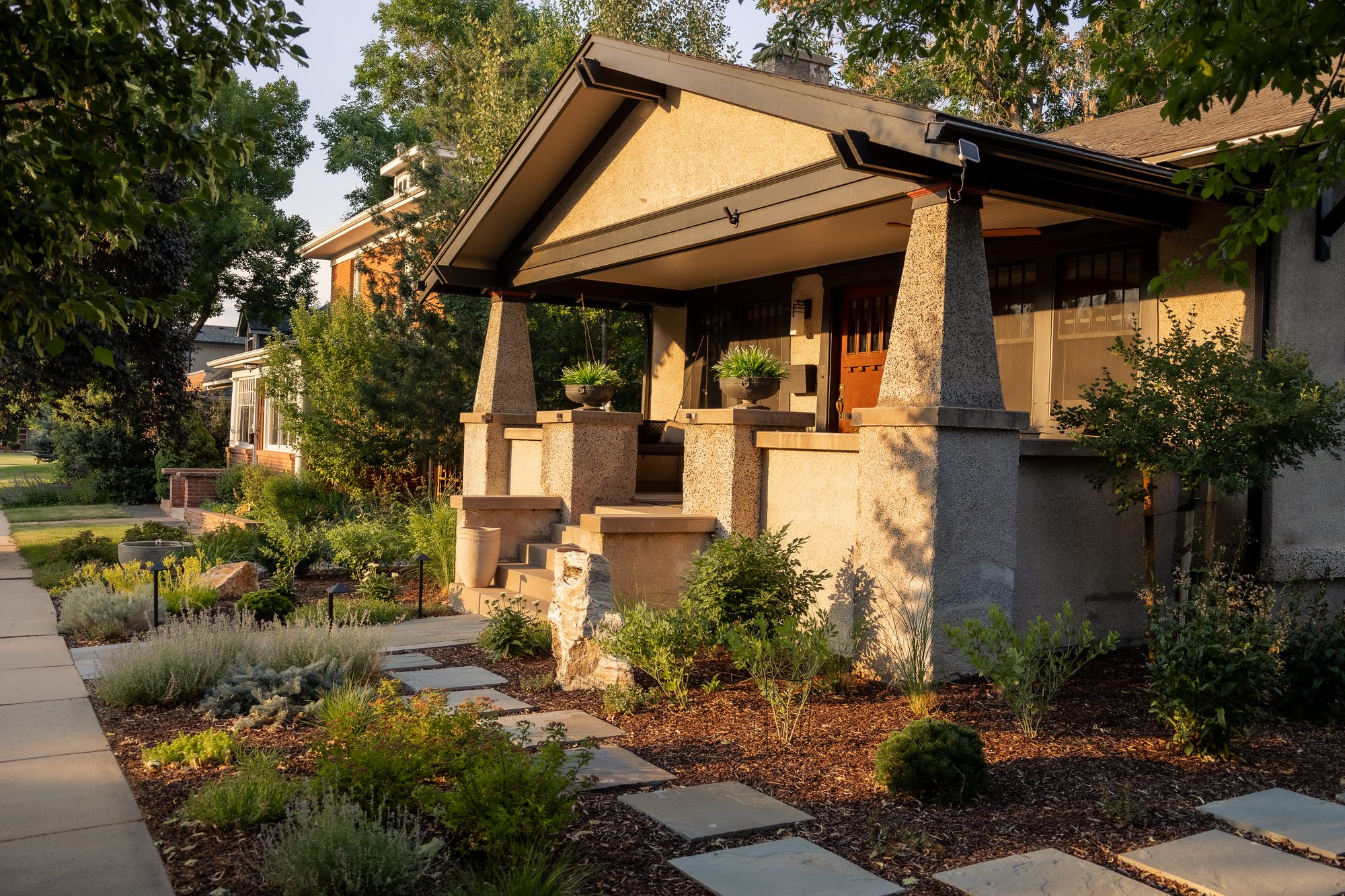
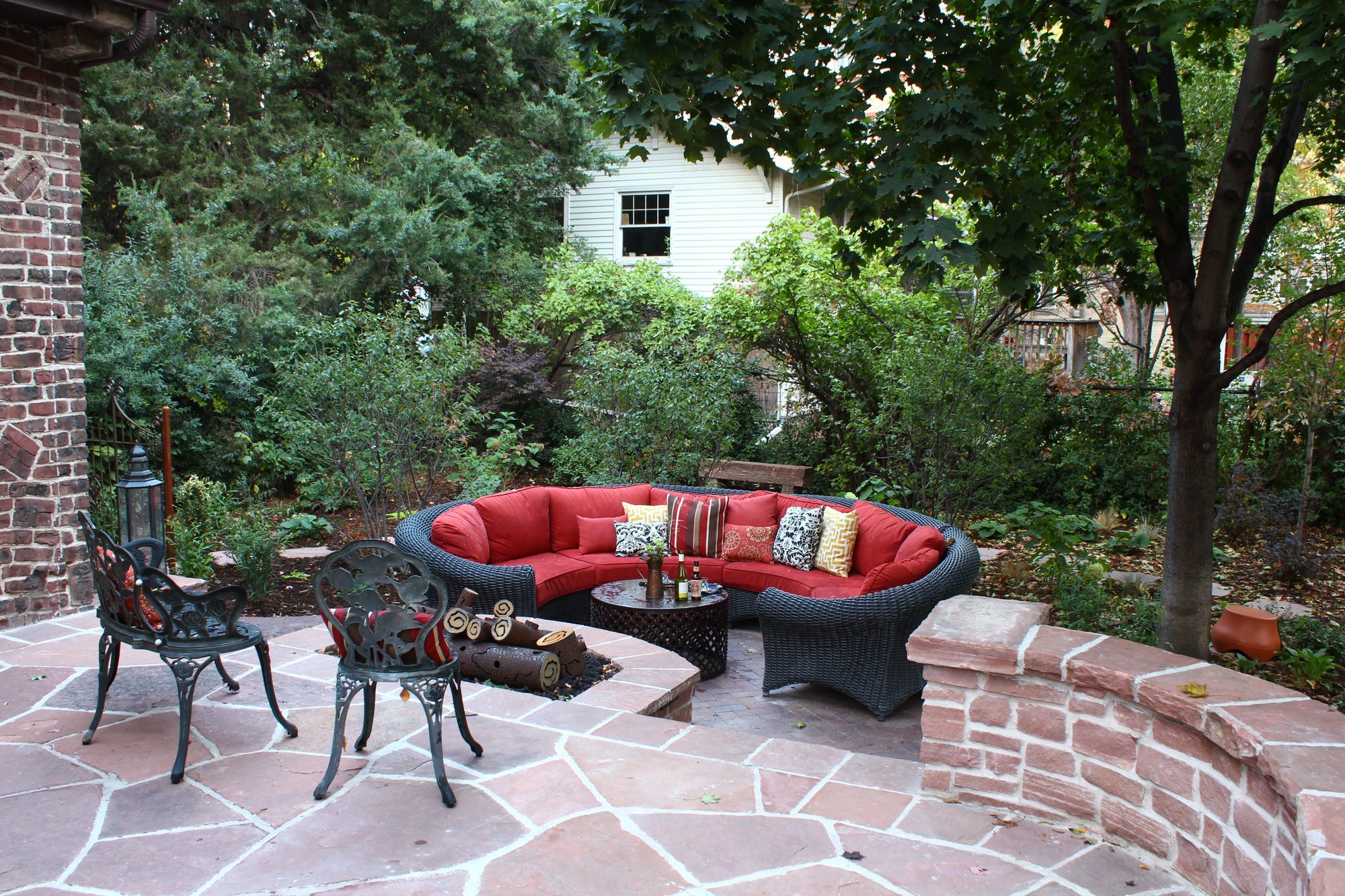
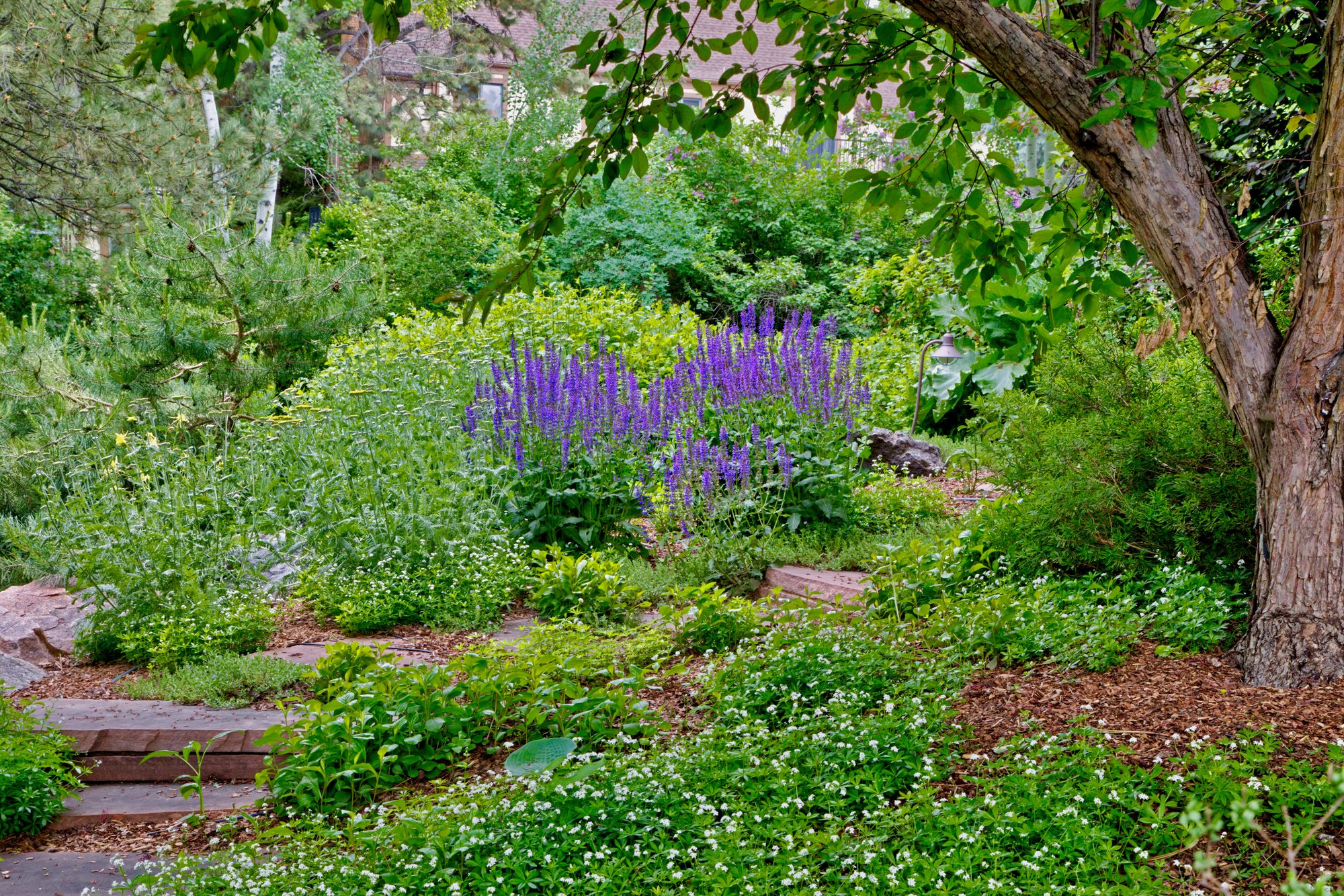
Layered planting, defined outdoor rooms and good lighting work well. Layers of trees, shrubs, perennials and groundcover give a large lot depth, and stone steps and boulders tie them to the grade. The goal is a yard that looks established and still handles water and wind.
Either can work. Ivy Street Design offers design-only or design-build services. Design-only gives you a complete plan you can bid to contractors. Design-build keeps design and construction under one roof. Our comparison explains who is accountable for what: Design-Build vs Design-Only Landscaping in Denver.
Either way, ask who will prepare your design review submission. A plan that already shows materials, plant lists and locations makes the committee's job easier. For how design fees are usually structured, see How Much Does Landscape Design Cost in Denver? Fee Guide.
Yes. Castle Pines is one of the Denver metro neighborhoods we serve, and we have designed Denver metro landscapes since 1992. Call us to talk through your lot and your association's requirements.
Start the design now, even in winter. Site analysis, a 3D presentation and design review can all happen before the ground thaws. That way you can build as soon as conditions allow.
Not in The Village at Castle Pines. Its Design Review Committee lists fire pits and retaining walls among items that need approval before work begins. Other communities have their own rules, so check with yours first.
It can be, but it is fixable. CSU Extension recommends working organic material into the top six to eight inches of soil before planting. We plan that into the planting scope.
Not every project does, but sloped lots, drainage and review submissions benefit from one. Read Landscape Architect vs Landscape Designer in Denver to see who to hire for what.
Call Ivy Street Design at (303) 320-0362 or visit ivystreetdesign.com to schedule a consultation.