Thanks! We have received your form submission, we'll get back to you shortly!
Oops! Something went wrong while submitting the form
A landscape architect's fee in Denver depends on the scope of the design, the difficulty of the site, and how the fee is structured. Ivy Street Design, a Denver landscape architecture and design firm, explains the three common fee models, what moves the price, and how to compare quotes without guessing.
Quick Summary
Homeowners usually ask about price first. That is fair, but a landscape architect's total is the end result of choices you can see and control. Once you know how the fee is built, quotes from different firms become much easier to read.
There is no single price. A Denver landscape architect sets the fee from the scope of the design, the condition of the site, and the fee model. Two yards of the same size can price very differently. Compare what each fee covers before you compare the totals.
Ivy Street Design has designed Denver metro landscapes since 1992, and the pattern holds across projects. A flat, level backyard with a clear wish list moves quickly. A sloped lot with drainage problems, walls, and several outdoor rooms takes more study and more drawing time. Neither is wrong. They are different jobs, and the fee should say so.
We are not quoting dollar amounts here because honest numbers depend on a site visit. What we can do is show you how the number is built.
Most landscape architects use one of three models: hourly billing, a fixed fee for a defined scope, or a percentage of the construction cost. Each one shifts risk differently between you and the designer. The right fit depends on how well the project is defined.
Some firms combine these. A common blend is a fixed fee for the first design phases and hourly billing for items that cannot be defined yet.
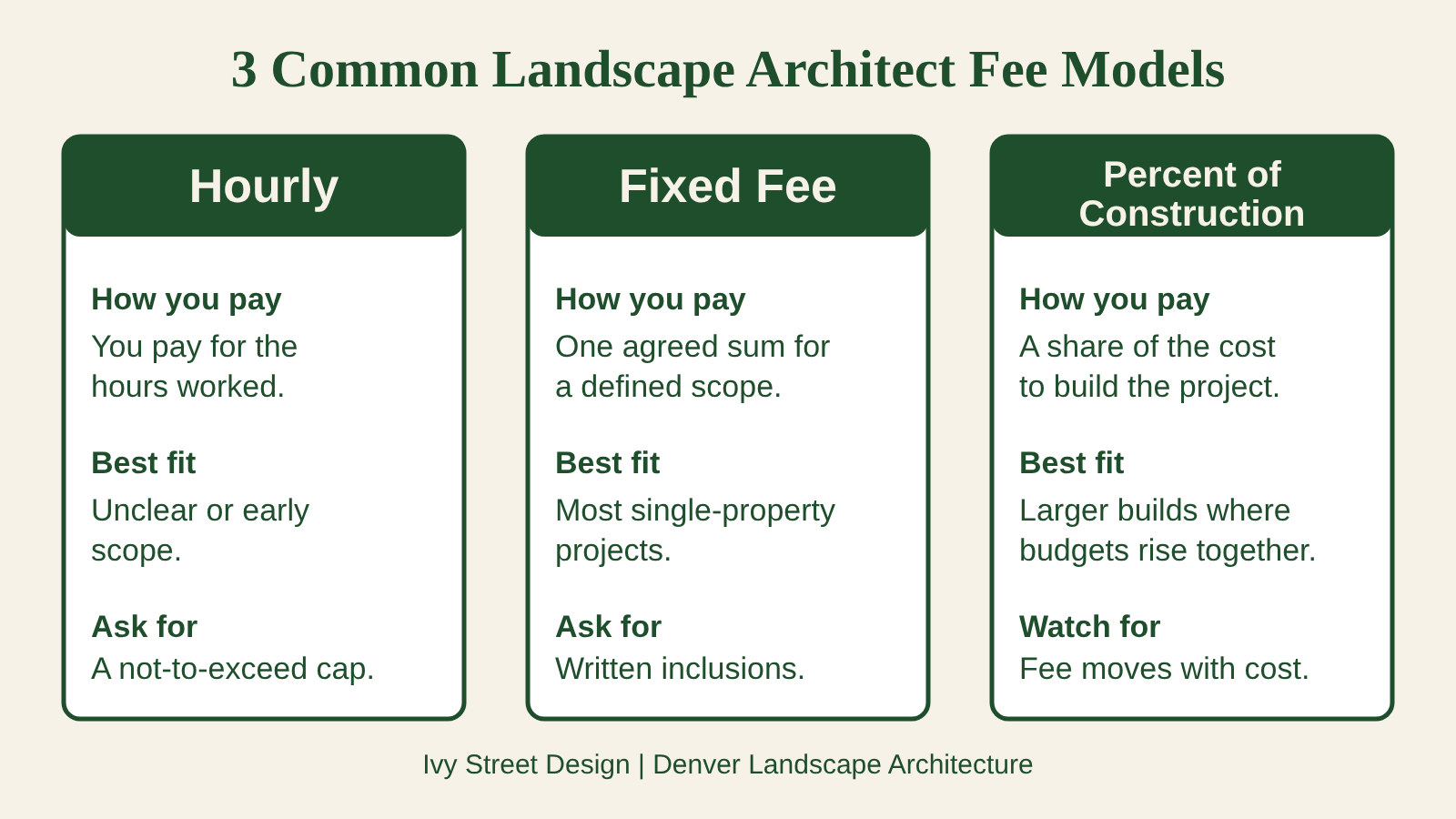
A fixed fee suits most single-property projects because the scope is bounded and you can budget design in advance. Hourly suits early exploration. A percentage of construction cost suits larger builds where the design and construction budgets rise together.
The model matters less than the clarity behind it. A fixed fee with vague inclusions leads to change orders. An hourly fee with a cap and regular updates can be just as predictable. Ask the firm to show you in writing what is in and what is out.
Five things move the fee most: how clearly the scope is defined, how complex the site is, how many design rounds you need, how involved permitting is, and how large the project is. Understanding these helps you control the number.
Presentation level also matters. Some firms itemize extras such as 3D renderings. Ivy Street Design includes a 3D presentation as part of its design process, so you can see the plan before it is built.
A landscape architect's fee usually covers the design phases from site study through final drawings, and it can extend to observation during construction. Exactly which phases are included varies by firm and by contract, so read the scope line by line.
At Ivy Street Design, the process includes site analysis, a 3D presentation, and construction observation. Here is how those pieces typically fit together:
If a quote leaves out one of these, ask why. Skipping construction observation, for example, can save money up front but leaves no one checking the build against the design.
Not automatically. Price follows scope and complexity, not the title alone. Colorado licenses landscape architects, and the state's Division of Professions and Occupations oversees the program through the Colorado Board of Landscape Architects.
The state's program page notes that licensure was re-established in 2007. For a deeper look at who to hire for which kind of yard, read our guide to landscape architect vs landscape designer in Denver. For a wider view of how design fees are set, see how much landscape design costs in Denver.
You can check the state's current program details on the Colorado Division of Professions and Occupations landscape architects page.
With design-only, you pay a design fee and then collect bids from builders. With design-build, one team designs and builds under a single relationship. The fee is structured differently in each, so ask how the design portion is priced and what happens if the build scope changes.
Ivy Street Design offers both. Neither is automatically cheaper. The better question is who is accountable for the plan, the budget, and the result. Our post on design-build vs design-only landscaping in Denver walks through that choice.
Compare quotes by scope, not by total. Line up what each includes, which phases are covered, how changes are handled, and who is on site during construction. A lower number with a smaller scope is not a lower cost for the same work.
Bring the same information to every firm so the quotes match. Then ask these questions:
Some do. Hourly billing is common when the scope is unclear or still developing. Many firms prefer a fixed fee for a defined scope, since it gives you a predictable design budget. If you choose hourly, ask for a not-to-exceed cap.
It is one of the recognized fee methods. The fee rises and falls with the construction budget, so it can change if scope or material prices change. Some homeowners prefer a fixed fee so the design cost is settled before the build is priced.
Usually the scope differs. One quote may include a 3D presentation, detailed drawings, and construction observation while another stops at a concept plan. Ask both firms to list inclusions and exclusions, then compare like with like.
Not in a design-only arrangement, where you pay for design and then hire a builder. In design-build, one team handles both, though the design portion is still defined separately. Confirm in writing which services your fee covers.
Define your goals before the first meeting, make decisions promptly, and agree on scope in writing. Late changes and unclear priorities add design time. A clear brief is the simplest way to protect your budget.
Call Ivy Street Design at (303) 320-0362 or visit ivystreetdesign.com to schedule a consultation.