Thanks! We have received your form submission, we'll get back to you shortly!
Oops! Something went wrong while submitting the form

An outdoor kitchen in Colorado costs the sum of its line items, and the biggest swings come from utilities, site work, and shelter, not the grill. Ivy Street Design has designed Denver metro landscapes since 1992, and we price outdoor kitchen design projects one line item at a time because a single total hides where the money goes.
Quick Summary
There is no single honest number, because a grill on a patio and a fully plumbed kitchen under a pergola are different projects. Cost depends on scope, site conditions, materials, access, permits, and design level. Labor and materials also vary by location, so a Denver quote reflects Front Range crews and conditions.
Online cost guides publish wide ranges, but those ranges blend small, simple setups with custom builds. For a high-end Denver yard, a better approach is to price each line item against a real design. That is how we work at Ivy Street Design, and it is why this article lists drivers instead of totals.
Six line items drive nearly every outdoor kitchen budget: appliances, structure and counters, utilities, site and base work, shelter and heat, and design and permits. Utilities and site work are the two homeowners most often underestimate, because they sit below grade and out of sight.
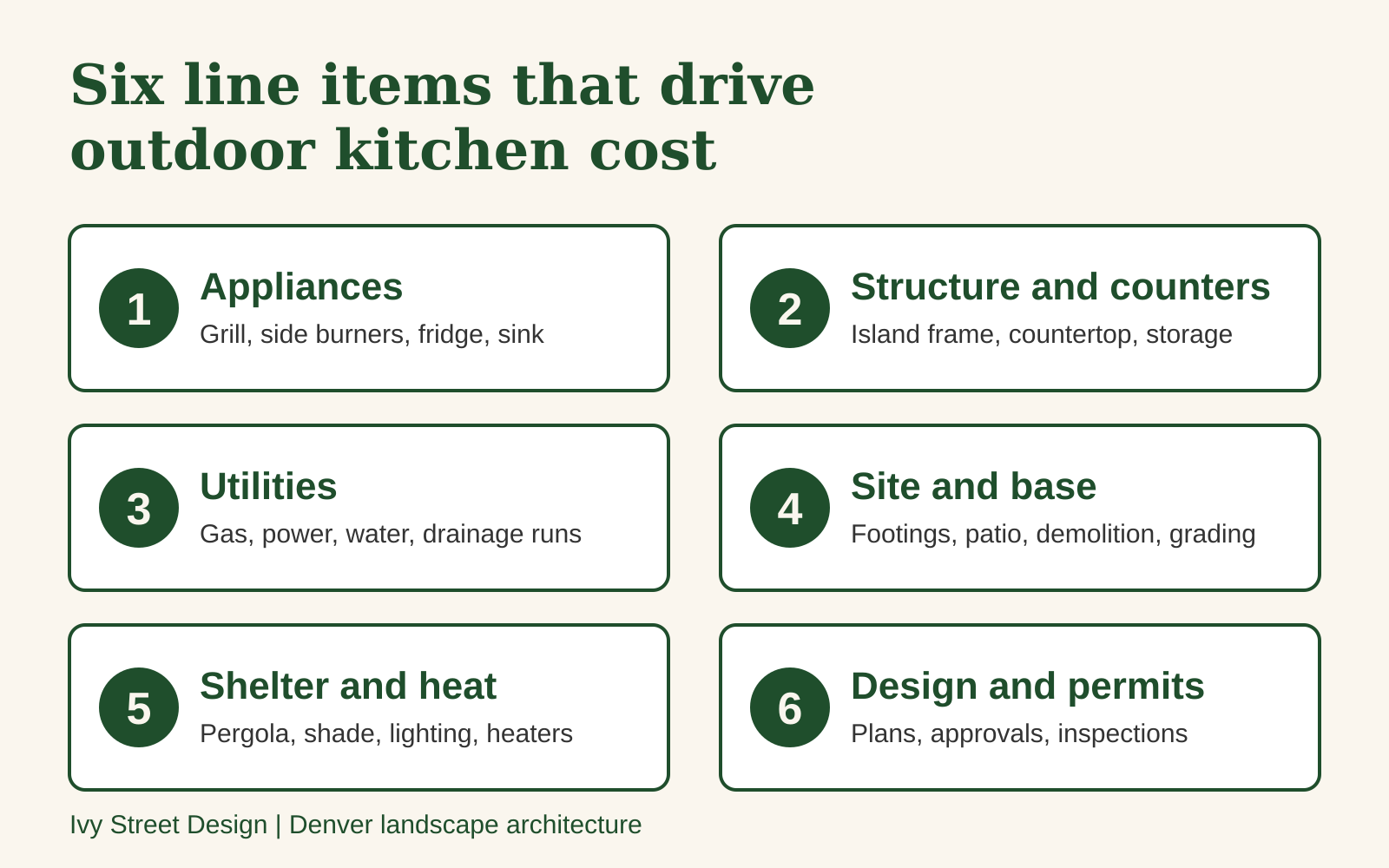
Utilities and site work surprise homeowners because they are invisible in the finished kitchen but real on the invoice. Running gas, power, water, and drainage to a new location means trenching, materials, and licensed trades. The farther the kitchen is from the house, the more of this work there is.
Two sources we reviewed make the same practical point. BBQGuys advises installing appliances close to existing utility lines to reduce labor expense, and building on an existing patio to avoid landscaping costs. Angi notes that removing an existing patio, deck, or landscaping makes demolition and site prep add to the total. You can read both in BBQGuys' cost guide and Angi's cost article.
In a design review, we look at where the kitchen wants to live for the view and the flow of the yard, then test that spot against where the utilities are. Sometimes moving the island a few feet saves real money. Sometimes the best spot is worth the extra trenching. The point is to make that trade on purpose.
These three line items are where taste meets budget. Each is a menu of choices, and each choice has a cost and a Colorado durability consequence.
For material detail and layout, see our earlier guide, Outdoor Kitchen Design: Cooking and Entertaining in Colorado's Climate.
Colorado weather adds cost mainly through material quality and shelter. Strong sun, big temperature swings, and freeze-thaw cycles punish soft materials and unprotected equipment. Angi notes that kitchens in harsh weather zones need more durable materials and weatherproofing, and our Front Range experience points the same direction.
Often, yes. Angi states that most outdoor kitchen projects require permits for building, electrical, plumbing, and gas work, and Denver's Community Planning and Development lists gas piping and exterior wiring among its trade-specific quick permits. Rules differ by city, county, and HOA, so confirm yours before you finalize a budget.
The City and County of Denver's Quick Permits page says quick permits are issued without plan review, and that most projects cannot be permitted that way, including structural work. It also says a permit from Wastewater, Zoning, or the Fire Department may be required depending on scope. A masonry island, a roof structure, or a service upgrade can land in plan review, which affects both schedule and fees. Outside Denver, check your own jurisdiction.
Start with a design, then price it. A design lets every bidder price the same scope, so you can compare line items instead of guessing at totals. It also lets you decide what to build now and what to rough in for later.
Our process starts with site analysis, adds a 3D presentation so you can see the layout and sightlines before anything is built, and includes construction observation so the finished kitchen matches the plan.
Is an outdoor kitchen worth the cost in Colorado?
It can be, when it is designed for how you will use it and built for our weather. Shelter, heating options, and durable materials stretch the season well beyond summer. Value is highest when the kitchen fits the yard and your cooking habits.
What costs more than people expect?
Utilities and site work, followed by shelter and permits. These sit out of sight or outside the appliance list, so they rarely show up in early estimates. Ask for them as separate line items.
Can I save money by building on my existing patio?
Often, yes, if the patio is in good shape and the layout works. BBQGuys notes that building on an existing patio avoids landscaping costs. A designer can confirm whether the base will carry an island before you commit.
Should I hire a designer before getting bids?
A design first gives every contractor the same scope to price, so bids compare cleanly. It also surfaces utility, drainage, and permit questions before they become change orders.
How long should I plan before building?
Plan design and permits well before construction starts. Winter is a good time to design, so you can build when the ground thaws.
A good outdoor kitchen budget starts with a plan, not a total. Ivy Street Design can map your yard, your utilities, and your cooking style into a design you can price with confidence.
Call Ivy Street Design at (303) 320-0362 or visit ivystreetdesign.com to schedule a consultation.