Thanks! We have received your form submission, we'll get back to you shortly!
Oops! Something went wrong while submitting the form
To hire a landscape architect in Denver, verify credentials with the state, ask to see finished projects like yours, get the fee structure in writing, and confirm who is accountable once construction starts. Ivy Street Design, a Denver landscape architecture and design firm that has designed Denver metro landscapes since 1992, hears these questions from homeowners every week, and we think you should ask all of them of any firm you interview, including ours.
Quick Summary
Check four things first: credentials, relevant completed work, how the firm handles grading and drainage, and how fees are set. Together they show whether a firm can handle a Front Range site and whether the price will make sense. Schedule and personality matter too, but only after these four hold up.
Many homeowners start with a portfolio and a quote. That is a fine start, but it skips the questions that decide how a project goes. A beautiful rendering means little if the plan ignores where water will run in a spring storm. A low fee means little if the scope is vague and every change becomes an add-on.
Treat the first meeting as an interview in both directions. A good firm will ask about your budget range, your lot, how you use the yard, and your timeline. If a firm only talks about itself, that tells you something.
Colorado has a State Board of Landscape Architects, and its website offers a licensee search, a licensee discipline lookup, and a way to file a complaint. Search the name of the person leading your project before you sign. If someone calls themselves a landscape architect, ask for their license and confirm it yourself.
The board's pages are public, so the check takes a few minutes. Look up the individual, not just the company name, and read any discipline record. You can start at the board's licensing services page, which links to its licensee search.
We are not lawyers, and the rules about which kinds of work require a license can be technical. If you are unsure whether a particular title or service is covered, ask the board directly. For a plain-language look at how the two roles differ, read our guide to landscape architect vs landscape designer in Denver.
A useful portfolio shows finished, built projects that resemble yours, not only renderings. Look for sloped lots, patios, walls, planting that has matured, and details like steps and lighting. Ask for references and, if possible, for permission to see a completed yard in person.
Photos taken the week a project finishes can hide problems. Ask how the plantings have grown in, how the hardscape has handled winter, and whether the owner would hire the firm again. A firm confident in its work will usually welcome these questions.
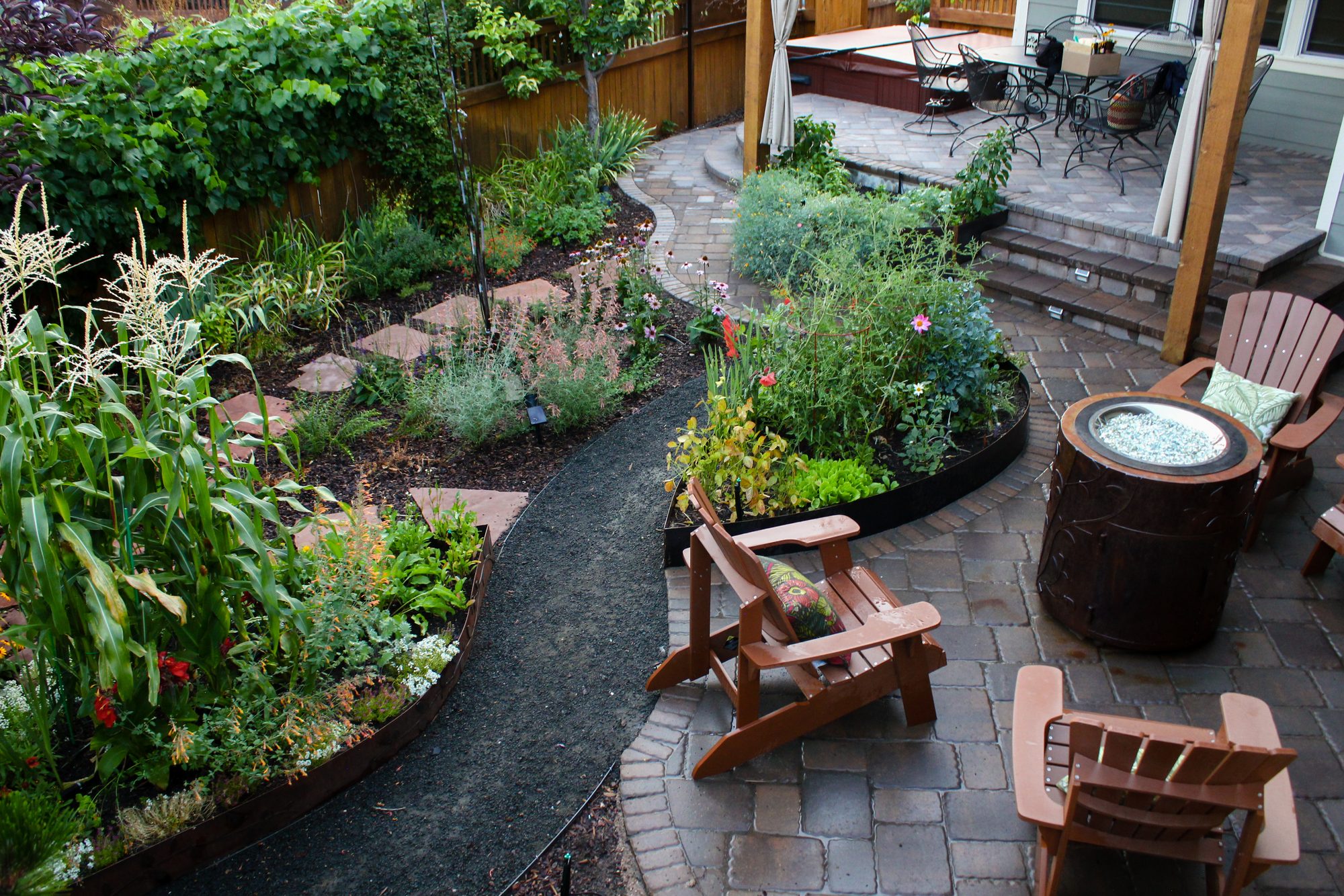
Notice the photo above. It shows a backyard where a curved gravel path separates planted beds, a paver patio steps up toward the house, and seating gathers around a fire table. Details like that, including edging, level changes, and the way a path leads the eye, are what to look for in any portfolio. They show planning, not just plants.
Ask about the design process, communication, technical problem solving, phasing, start date, fees, contractor recommendations, design-build, maintenance, and fit. Board & Vellum, a Seattle design firm, publishes a similar list of ten questions in its guide to interviewing a landscape architect or designer. We adapted it for Denver:

Design fees are usually set as a retainer, an hourly rate, a fixed fee, or a lump sum. The method matters less than clarity. Your agreement should say what drawings you receive, how many revisions are included, and whether the firm visits the site during construction.
Fees depend on scope, site conditions, the level of design detail, and whether permits or specialty consultants are involved. Be careful with quotes that look much lower than others, since the gap often comes from a thinner scope. Our guide to what a landscape architect costs in Denver explains the fee models in more detail.
Ask for the deliverables in writing. A concept plan, a 3D presentation, construction drawings, and planting plans are different pieces of work, and some firms price them separately.
It depends on how much coordination you want to manage yourself. In a design-only arrangement, the firm produces the plans and you hire a contractor. In design-build, one team designs and builds, which can simplify accountability. Ivy Street Design offers both.
With design-only, ask whether the firm will observe construction so the built result matches the drawings. With design-build, ask how design decisions are separated from construction pricing. Our comparison of design-build vs design-only landscaping in Denver walks through who is accountable for what in each model.
Whichever route you pick, a good firm will explain the tradeoffs plainly and will not push you toward the option that suits the firm. You should also hear how long each phase typically takes. See how long a landscape design project takes in Denver for a typical sequence.
Several warning signs show up repeatedly. Any one of them is a reason to pause and ask more questions:
Start with referrals from neighbors and friends whose yards you admire, then look at firm websites for finished projects. Shortlist two or three firms and interview each. Verify licenses with the State Board of Landscape Architects before you sign.
It depends on the project. Complex sites with slopes, drainage, walls, and multiple structures benefit from detailed design and construction drawings. Simpler planting updates may need less. Ask each firm what is included and verify credentials either way.
Yes. Many homeowners pay for the design and then hire their own contractor, or choose design-build. Ivy Street Design offers both. If you go design-only, ask whether the firm will observe construction.
Bring a rough budget range, photos of your yard, any plat or survey you have, and notes on how your family uses the space. Include problems like drainage, steep areas, or shade. Clear priorities make the first meeting far more useful.
Plan a few weeks to interview firms, check references, and compare written scopes. Rushing the choice is a common mistake. A short delay at this stage costs less than fixing a mismatch later.
Ready to talk it through? Call Ivy Street Design at (303) 320-0362 or visit ivystreetdesign.com to schedule a consultation.