Thanks! We have received your form submission, we'll get back to you shortly!
Oops! Something went wrong while submitting the form

A good front yard landscape design in Denver keeps a small, useful patch of lawn, fills the rest with low-water plantings, paths and structure, and gets reviewed against your HOA's rules before anything is built. Ivy Street Design, a Denver landscape architecture and design firm that has designed Denver metro landscapes since 1992, plans front yards as one connected system so the result looks sharp from the street and uses far less water.
Quick Summary
A water-smart front yard replaces the large, uniform lawn with a layered plan: a smaller grass area, planting beds grouped by water need, and paths and edges that give the yard shape. The goal is lower water use without losing curb appeal. Design carries the look, not the amount of lawn.
This matters in Denver because outdoor watering is where much of the water goes. Colorado State University estimates, as cited on its news page in 2023 coverage, that outdoor use accounts for nearly 55 percent of residential water use along the Front Range, mostly on lawns. Denver Water has also described the current moment as the largest collective focus on landscape change it has seen, and it led a basin-wide agreement among water providers to cut nonfunctional turf, meaning grass used only for decoration, by 30 percent.
A front yard is also the part of the property neighbors, guests, and future buyers see first. That is why we design it as a composition: lines from the street, a clear route to the door, and plants that look good across the seasons.
Keep lawn only where people actually use it, such as a play area, a dog run, or a green panel that frames the entry. A smaller grass patch uses less water and looks deliberate when beds and edging define it. For most yards, the answer is less lawn than you have now.
The 5280 water-wise landscape guide, which draws on Denver Botanic Gardens and Sterling Ranch, suggests growing grass as smaller "rugs" instead of full lawns, because grass is a heavy water user. We use the same idea in design. Shape the lawn as a clean rectangle or gentle curve, edge it with steel or stone, and let the beds around it carry the color and texture.
Notice how the photo above handles it: a strip of lawn sits beside mulched beds of ornamental grasses, boulders, and young trees, with a small seating area at the entry. The yard reads as designed, not as a lawn with plants dropped around it.
Most likely yes, if your home sits in an HOA. You should submit plans for review before you build. According to Denver Water, state law no longer lets HOAs require water-intensive lawns and requires them to allow water-smart landscaping. Your association can still review plans, so clear drawings help.
We cannot give legal advice, and rules differ by community and by the date a covenant was written, so read your governing documents and ask your management company for the review process. What we can do is make the review easier. Our design process includes site analysis and a 3D presentation, so your board sees plant placement, scale at maturity, and materials before approving. Our garden and planting design service is built around exactly this kind of plan.
A simple checklist for submittal helps:
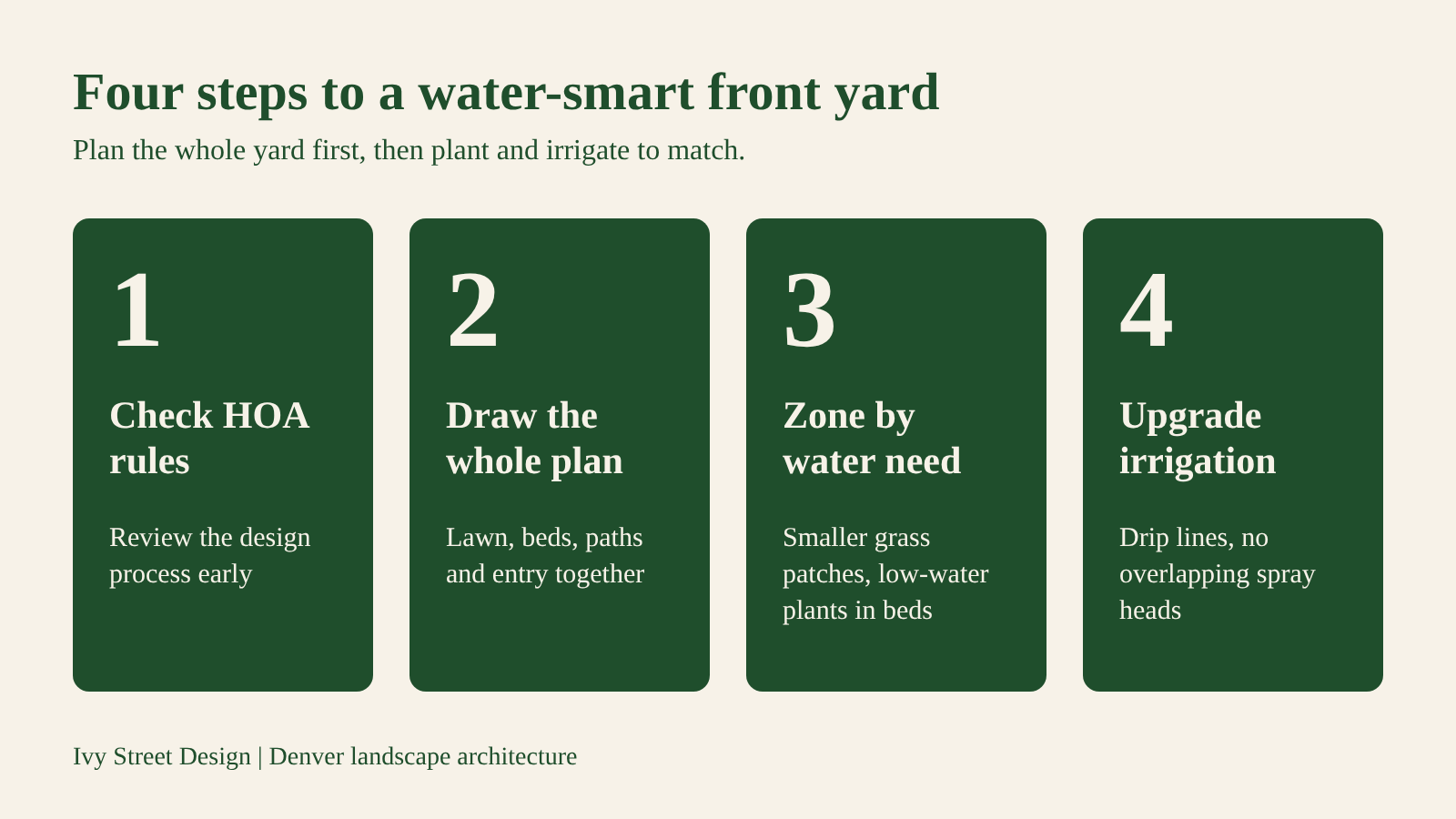
Group plants by water need, use mulch over bare soil, and switch to drip irrigation where you can. Start with a whole-yard plan so water-hungry plants sit together and low-water plants fill the rest. Then match the irrigation zones to those plant groups.
The 5280 guide recommends choosing plants from a list organized by water needs and names low-water trees such as juniper, pine, and locust, along with grasses like Karl Foerster and blue oat grass. It also notes that drip lines put water into the root system with no loss to evaporation, and advises replacing old sprinklers and checking that heads are not overlapping. Denver Water's reporting adds that smarter irrigation timing and sprinkler heads can cut water use meaningfully, with landscapers quoted at 15 to 30 percent or more.
In practice, we think about the front yard in zones:
Paths, stone, edging, and a few evergreen or structural plants. When beds go dormant in winter, these elements keep the yard from looking empty. A well-placed path also tells visitors where to walk, which protects your plantings.
Boulders, stepping stones, steel edging, and a defined walk to the door do the heavy visual lifting. If your front yard shares a driveway edge, see how permeable surfaces can help in our post on permeable pavers for Denver driveways. Add landscape lighting along the path and you get a front yard that works at night, too.
Decide how you use the front yard, what your HOA requires, and how much lawn you actually want. Then bring photos of what you like and any covenants. Those three decisions shape the whole design and speed up your first meeting with a landscape architect.
It also helps to know whether you want design only or design-build. Ivy Street Design offers both. Design-only gives you a complete plan to bid with contractors of your choice, and design-build carries the plan through construction. Either way, our process includes construction observation, so the finished yard matches the drawings.
Can I remove my entire front lawn in Denver?
Often yes, but it depends on your HOA and any local rules for your property. Per Denver Water, state law requires HOAs to allow water-smart landscaping. Confirm your community's review process before you remove anything.
What is the best low-water plant style for a Denver front yard?
Layered plantings of ornamental grasses, low-water shrubs, and perennials in mulched beds work well, with a few evergreen trees for winter structure. The 5280 guide names juniper, pine, and locust as low-water trees. A landscape architect can match choices to your sun, soil, and slope.
Does drip irrigation really save water?
Yes. The 5280 guide notes that drip lines deliver water to the roots with no loss to evaporation. Landscapers quoted by Denver Water say smarter timing and sprinkler heads alone can cut use by 15 to 30 percent or more.
How early should I involve my HOA?
Before you finalize the design. Ask for the review process and submittal requirements first. Then build the drawings and visuals to match, so the board can approve without guessing.
Do I need a landscape architect for a front yard?
Not always, but a plan helps most when you have an HOA, a slope, drainage, or a mix of lawn, beds, and hardscape. A landscape architect coordinates all of it on one set of drawings.
Call Ivy Street Design at (303) 320-0362 or visit ivystreetdesign.com to schedule a consultation.
Sources: Denver Water, "It's not so easy (anymore) being green"; 5280, "7 Expert Tips for a Water-Wise Landscape Design"; Colorado State University news page, Colorado Springs Gazette excerpt, April 2023.