Thanks! We have received your form submission, we'll get back to you shortly!
Oops! Something went wrong while submitting the form

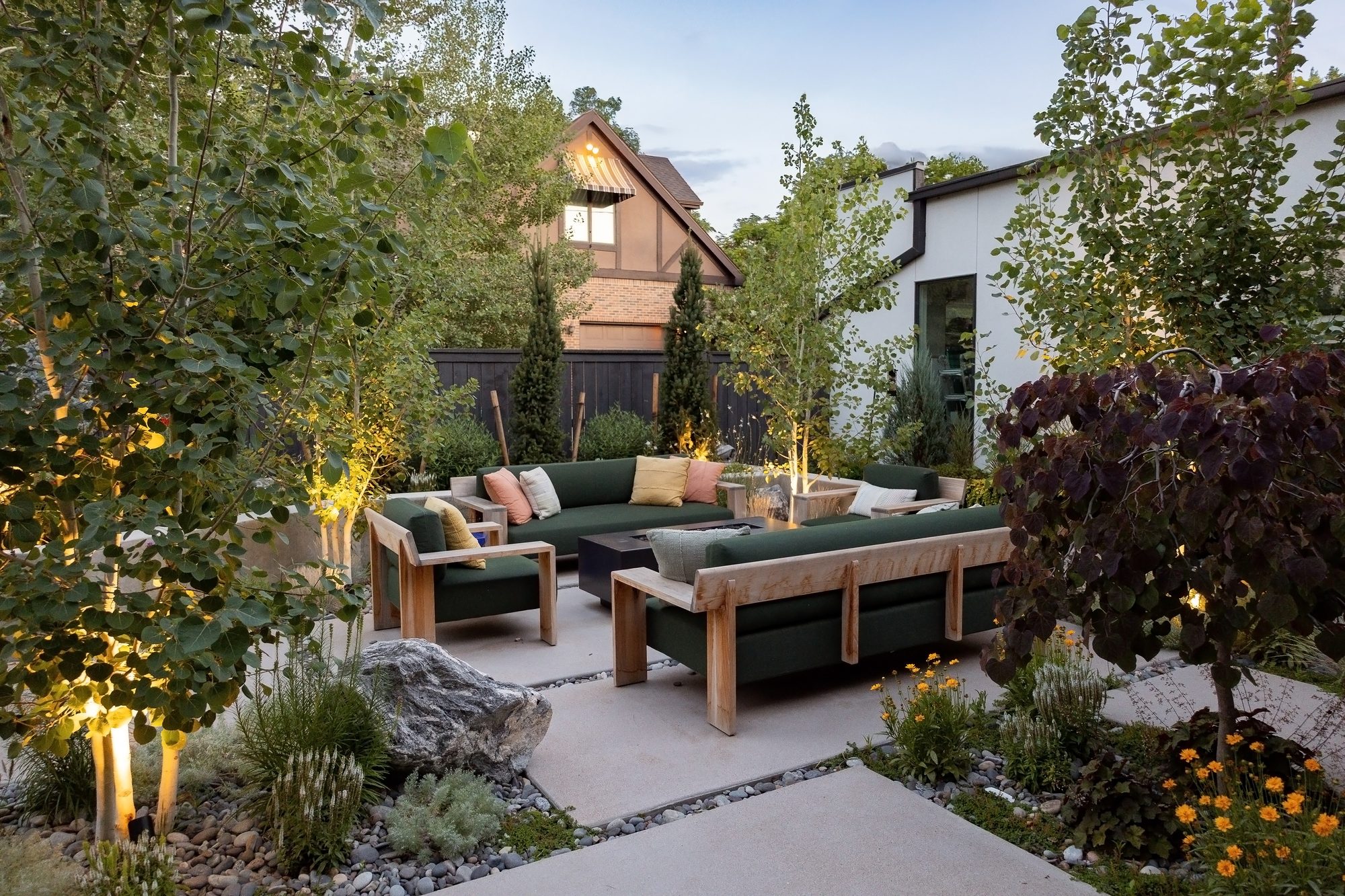
Outdoor fireplace design in Denver starts with a fuel decision, not a stone choice. Denver restricts open wood burning, so most homeowners are better served by a gas-fired fireplace built into a well-designed patio. Ivy Street Design has designed Denver metro landscapes since 1992, and here is how we plan a fireplace that works with the city's rules, the wind, and four seasons of use.
Quick Summary
Denver does not treat an outdoor fireplace like a backyard cookout. The city's fire department says open burning of wood is outlawed without permits, and that permits are rarely issued to individuals. A gas-fired design avoids that problem and is the practical path for most Denver yards.
That rule is the gap in most online advice. National articles compare brick and stone and never mention that the fuel you pick may decide whether the fireplace is legal to use. Denver's own Home Fire Safety page says permits are never issued for chimineas, and that open burning needs approval from two agencies, the Denver Department of Environmental Health and the Fire Prevention and Investigation Division.
The department's residential heat-producing devices policy, which lists 2019 effective dates, adds that listed natural gas appliances are allowed on patios when installed under the International Fuel Gas Code. It also says devices used only for outdoor noncommercial cooking do not need a permit. Rules change, so confirm your specific plan with the Denver Fire Prevention Division at 720-913-3474 before you build. If you are outside the city limits, your own city or fire district may have different rules.

For most Denver homeowners, gas. Gas is the fuel Denver's policy explicitly allows on patios, it starts and stops with a switch, and it leaves no ash. Wood gives real crackle and aroma, but it needs a permit that is rarely granted, so it is hard to plan a design around.
Gas still has design consequences. Natural gas needs a line routed to the fireplace, and that line shapes where the fireplace can sit and how the patio is built. Propane avoids the trench, but Denver's policy limits one- and two-family homes to 40 pounds of propane, or two 20-pound cylinders, on the premises. The same policy says LP-gas is prohibited where a natural gas source is within 300 feet of the nearest property line, so ask about natural gas service early. Installation should be done by qualified gas technicians, and carbon monoxide alarms belong near any enclosed living areas.
If you are still weighing a freestanding fire pit against a fireplace, our guide to fire pit design in Denver covers layout and seating distance.
Choose masonry when the fireplace is the architectural centerpiece and the budget supports custom work. Choose a prefabricated or modular unit when you want a predictable footprint and a shorter build. Both can look custom once finished, because the surround is where the design happens.
The same trade article notes that piers may be needed in cold climates or unstable soil, and that local codes or a concrete contractor should be consulted. On the Front Range, treat the footing as part of the design, not an afterthought. Build on a noncombustible base such as concrete or masonry, and keep the unit well away from siding, fences, pergolas, and overhanging branches.
Place the fireplace where wind, sightlines, and seating all agree. Face seating toward the fire and the best view, keep the chimney clear of tree canopy and roof edges, and avoid spots where prevailing wind funnels smoke back at guests.
Wind is the Front Range variable that catalog photos ignore. A fireplace in a sheltered corner of a patio behaves very differently from one at an exposed edge. During site analysis, we look at how air moves through the yard, where the neighbors' windows and trees sit, and where people will actually sit in the evening.
Leave comfortable walking space between seating and the fireplace opening, and keep a clear path to the house. A raised hearth can double as extra seating, but it should never block the route to the door.
Fireplaces pair well with a pergola or covered area because the structure frames the hearth and breaks wind. Keep combustible beams and overhead structures at safe clearances from the firebox and chimney, and confirm those distances with the unit's installation instructions and your inspector.
Design the whole patio around cold-weather use, not just the fireplace. Put the fireplace where winter sun reaches seating, add a windbreak on the exposed side, and light the area so the path, steps, and hearth are visible after dark.
We begin with a site analysis, then present the design in 3D so you can judge scale, flame height, and how the fireplace sits within the whole landscape. From there we coordinate details such as gas line routing and, on projects where we are engaged for it, observe construction so the finished work matches the plan.
You can hire us for design only or for design-build. Some homeowners start with design to settle the fuel, footprint, and budget questions, then decide who builds. Our fire feature design service covers fire pits, fireplaces, and related features for Denver homes.
Denver Fire Department guidance says open burning of wood is outlawed without permits, and permits are rarely issued to individuals. Check with the Fire Prevention Division at 720-913-3474 about your situation before planning around wood.
Denver's residential policy says listed natural gas appliances are allowed on patios when installed under the International Fuel Gas Code. Propane has storage limits for one- and two-family homes. Confirm your exact setup with the city.
It depends on the type. A trade article describes a modular masonry kit as roughly two days for a three-person crew, while custom masonry takes longer. Footings, gas lines, finishes, and inspections add time to either one.
Requirements vary by property and city, so confirm permits, inspections, and any HOA approval with your local building department and association before you build. Ivy Street Design manages permits and HOA approvals as part of full-service project management.
Yes, if clearances allow. A compact pre-engineered unit or a wall-integrated fireplace uses less space than a freestanding masonry structure. Placement relative to fences, trees, and the house matters more than total yard size.
Ready to plan an outdoor fireplace that fits your yard and Denver's rules? Call Ivy Street Design at (303) 320-0362 or visit ivystreetdesign.com to schedule a consultation.